
FOIA vs Court Records in Loudoun County
Virginia uses two systems for public access, and they do not overlap. The Freedom of Information Act covers records held by public bodies, like county departments and the Sheriff. Court case files follow judicial-branch rules and court-record statutes instead. So a county agency record is a FOIA request, while a court file is a request to the Clerk or a search in the state case system.
This split matters for every request. If you want a county budget, a permit file, or a sheriff report, FOIA is the path. If you want a divorce file, a criminal case, or a recorded deed, the Clerk of the Circuit Court is the path. The Loudoun FOIA hub is the county's central page for administrative requests.

The hub links the request procedures, costs, exemptions, and the county FOIA officer.
How to File a Loudoun County FOIA Request
A FOIA request does not need a special form, but it does need clarity. The law asks you to identify the records with reasonable specificity so the agency can find them. A vague request slows everything down. These steps keep a request on track.
- Decide which body holds the record: a county department, the Sheriff, or the Clerk.
- Describe the records you want with reasonable specificity.
- Send the request to that body's FOIA officer or records desk.
- Ask for a cost estimate if you expect a large or complex request.
- Watch for the response, generally due within five working days.
Note: A public body must respond within five working days, but the response can be the records, a cost estimate, or a lawful reason for delay or exemption.
What the Clerk and Courts Maintain
The Clerk of the Circuit Court keeps far more than court cases. The office records deeds and land documents, issues marriage licenses, handles probate, manages jury services, and preserves historic records dating to 1757. These are not FOIA records in the usual sense; they are court and land records with their own request and copy processes.
So a request for a deed, a will, or a case file goes to the Clerk, not the county FOIA officer. The Clerk of the Circuit Court page links the division-specific request and copy options. For case searches, the court records page explains the online system.
Historic Loudoun County Records
Loudoun has an unusually deep public record. The Clerk's Historic Records and Deed Research Division keeps county court records dating to the county's formation in 1757. The Clerk says Loudoun holds one of the most complete court-record collections in Virginia, because its records were never destroyed by fire, war, or weather. For a public-records researcher, that is a real advantage.
It also means older deeds, wills, chancery files, and court orders may be available here that are simply gone in burned-record counties. The historic office supports research but does not do open-ended research for the public. Visitors are asked to use the online indexes and research tips first, and no food or drink is allowed in Historic Records. Deeds and land records can also be reached through the Clerk's remote access service.
Sheriff Records and Law-Enforcement Reports
Law-enforcement records are their own category. The Sheriff's Office has a Records Services unit and its own public-record request process for police reports and related records. A crash report or an incident report is requested from the investigating agency, which is often the Sheriff, but could be a town police force, the State Police, or airport-authority police depending on who responded.
The Sheriff's Records Services page handles these law-enforcement record requests.

For news, contacts, and agency links, the main Sheriff site is the starting point.

Routing a report request to the Sheriff, rather than the county FOIA officer, gets it to the office that actually holds it.
FOIA Fees and Actual Cost
FOIA is not always free, but the charges are limited. Under Virginia Code § 2.2-3704, a public body may charge no more than the actual cost of accessing, duplicating, supplying, or searching for records. The table sums up the main cost rules.
| Rule | Detail |
|---|---|
| Charge limit | No more than the actual cost of the work. |
| Cost estimate | A requester may ask for an estimate before work begins. |
| Deposit | A deposit may be required when expected charges top $200. |
| New records | A body need not create a new record, but may summarize by agreement. |
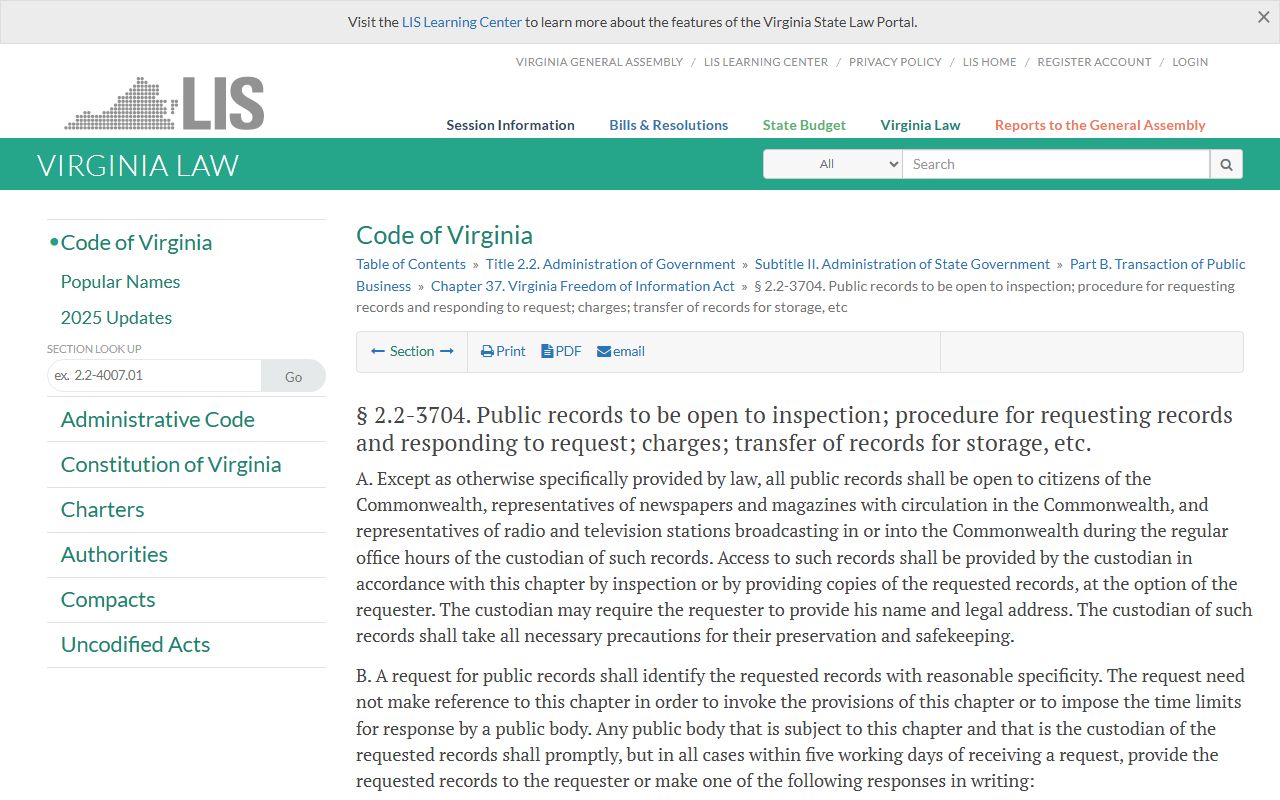
The procedure statute also covers electronic records, which must be supplied at reasonable cost in a usable format where possible.
FOIA Policy and the Presumption of Access
Virginia's FOIA starts from openness. Under Virginia Code § 2.2-3700, public records and meetings are presumed open unless an exemption is properly invoked. The law says it should be read in favor of awareness of government activity, and exemptions should be read narrowly.
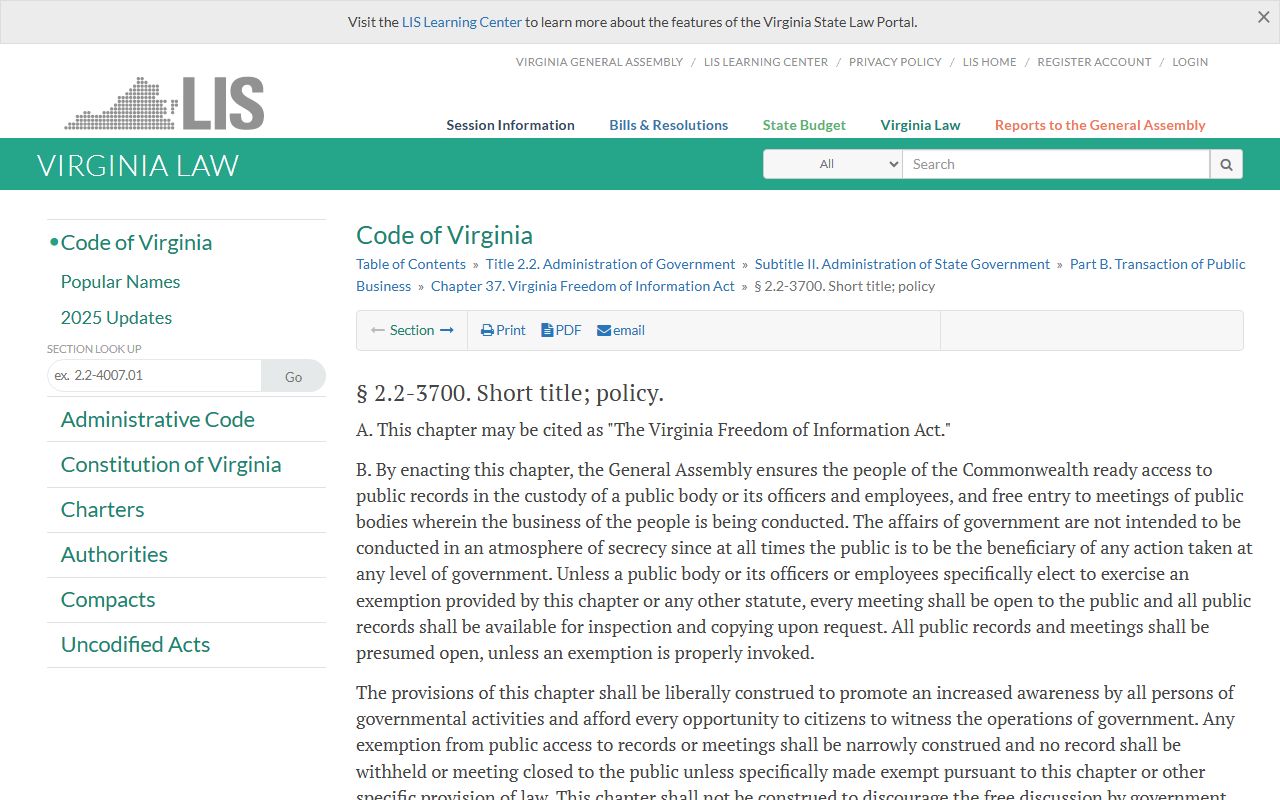
That presumption is the reason most county records are reachable. The burden falls on the agency to justify withholding, not on you to justify asking.
Confidential Records and Exemptions
Openness has limits. Some records are exempt or confidential by law. Juvenile court records, adoption records, sealed and expunged criminal records, and protected identifying information stay closed. Active criminal investigative files, personnel records, and certain other categories may be withheld under specific FOIA exemptions.
This is why a request for "all records about a person" often comes back narrowed. The agency releases what is public and withholds what an exemption covers. A focused request, aimed at the right body, almost always works better than a broad one. When part of a record is exempt, the body can remove just those fields and still release the rest, since redacting an exempt field is not the same as creating a new record.
What a Good Records Request Includes
A strong request has a few common parts, whether it goes to the county, the Sheriff, or the Clerk. Including them up front avoids back-and-forth. The table lists the elements that help.
| Element | Notes |
|---|---|
| Requester contact | Name and a way to reach you with the response or an estimate. |
| Record description | Identify the records with reasonable specificity, including dates if known. |
| Custodian | Send it to the right body: county FOIA, Sheriff, or Clerk. |
| Format | Note whether you want paper or electronic copies. |
| Cost cap | State a cost limit or ask for an estimate first. |